

Épisode 1 : La Lettre de Paris
Ouverture
L'île de Skye s'éveille lentement. La brume s'accroche à la lande comme un souffle retenu dans l'air d'hiver, et la lumière—quand elle vient—est pâle et austère, jetant tout dans des teintes de gris et de brun-bruyère. Le vent porte l'odeur salée et vive de l'Atlantique, et sous elle, la richesse terreuse de la tourbe et de la pierre mouillée.
Màiri MacLeod traverse ce paysage comme si elle en faisait partie—ce qui, d'une certaine manière, est devenu le cas. Ses mouvements sont économes, rodés, le résultat de vingt-trois années de matins exactement comme celui-ci. Les moutons connaissent le bruit de ses pas. La terre connaît sa silhouette contre l'aube.
Elle s'agenouille près de la brebis à face noire avec le genre d'attention que la plupart des gens réservent à la prière. Ses mains lisent le corps de l'animal comme un texte, trouvant le problème, évaluant, planifiant. Il n'y a pas de hâte en elle. Il n'y a que le travail, et la certitude que le travail compte—que cette brebis agnellera ou mourra, que le troupeau prospérera ou se dispersera, et que l'un ou l'autre résultat sera, d'une manière fondamentale, sa responsabilité.
« Oui, ma belle, je vois ça, » murmure-t-elle, brossant la terre du sabot de la brebis. « Juste un petit caillou, rien qui ne guérira pas. »
Quand Lachlan Morrison apparaît sur le sentier—son Land Rover rouge visible au loin, se rapprochant—Màiri ne lève pas immédiatement les yeux. Elle connaît le son de son pas, le rythme de son approche. Leur silence, quand il arrive, n'est pas le silence d'étrangers. C'est le silence de gens qui ont appris à parler sans mots.
« Bonjour, Màiri, » dit-il, posant sa trousse de vétérinaire. « J'ai entendu dire que tu pourrais avoir besoin d'aide avec cette brebis. »
Elle se redresse, notant le poids familier de compétence qu'il porte. « La brebis à face noire près du mur du fond. Elle est agitée depuis hier. »
Ils travaillent ensemble sans autre conversation. Lachlan Morrison s'agenouille près de l'animal, les mains douces mais sûres. « Oui, elle en voit de toutes les couleurs. Des jumeaux, d'après ce que je sens. »
Le travail se déroule entre eux comme une danse rodée. Quand les agneaux arrivent—glissants et haletants dans l'air froid du matin—Lachlan Morrison s'essuie les mains sur son pantalon et regarde la lande qui s'étend à l'infini vers l'horizon.
« Le vent tourne, » dit-il doucement. « La pluie arrive de l'ouest d'ici ce soir, je dirais. »
Màiri regarde les agneaux nouveau-nés trouver la chaleur de leur mère. Il y a quelque chose de sacré dans ce moment—le rythme ancien de la vie qui continue, indifférent à tout sauf à sa propre nécessité.
« Ton père serait fier, » dit Lachlan Morrison, et quelque chose dans sa voix la fait se tourner. « De la façon dont tu gères le troupeau. »
Il hésite, comme s'il rassemblait son courage pour quelque chose de bien plus difficile que de mettre au monde des agneaux jumeaux dans une aube des Highlands.
« Màiri... J'y pense. À nous. À rendre les choses plus stables. Officielles, en quelque sorte. »
Les mots restent suspendus entre eux, lourds d'un sens que ni l'un ni l'autre n'a vraiment nommé à voix haute. Elle ouvre la bouche pour répondre, mais le moment se brise—le bruit d'un moteur qui approche, faux et intrusif dans ce lieu sauvage.
Une voiture noire franchit la crête.
L'Étranger
C'est le genre de véhicule qui appartient aux villes où les gens ont oublié ce que sont les moutons. Elle repose sur le chemin boueux comme un corbeau dans un nid de brindilles, totalement déplacée, en quelque sorte accusatrice.
Le temps que Màiri atteigne son cottage, l'homme attend. Il porte un manteau qui n'a jamais touché la boue, des chaussures qui n'ont jamais connu l'argile particulière de Skye. Ses cheveux sont parfaitement arrangés. Son expression est le masque soigneusement neutre de quelqu'un formé à délivrer des nouvelles difficiles tout en maintenant une distance professionnelle.
Il est, sans équivoque, français.
« Mademoiselle MacLeod ? » Son accent rend les syllabes de son nom étranges à ses propres oreilles. « Je suis Philippe Gauthier, notaire de Paris. Je m'excuse d'arriver sans rendez-vous, mais... l'affaire est d'une certaine urgence. »
À l'intérieur du cottage, le feu de tourbe crépite dans l'âtre. La cuisine est assez petite pour que, lorsque Màiri s'assoit à la table et que Philippe prend la chaise en face d'elle, leurs genoux soient presque assez proches pour se toucher. L'espace semble soudain comprimé par le poids de sa formalité.
Les documents s'étalent sur le bois usé comme une malédiction.
Des photographies de Paris. D'un bâtiment qui ressemble à un palais, tout en pierre pâle et balcons en fer forgé. De pièces plus grandes que tout le cottage de Màiri, remplies de tableaux et de meubles qui ont probablement des noms et des histoires et des prix qui lui donneraient le vertige.
Et une photographie d'une femme dont elle se souvient à peine. Élégante. Distante. La seule grand-mère que Màiri ait jamais connue, et encore seulement dans l'abstrait—une visiteuse quand elle avait sept ans, sentant le parfum cher, parlant français à son père sur des tons bas et urgents qui suggéraient une dispute.
Elle est morte.
Et elle a tout laissé à Màiri.
« Madame Élise Beaumont est décédée il y a trois semaines, » dit Philippe, observant son visage attentivement. « Elle vous a nommée comme son unique héritière. La succession comprend un hôtel particulier dans le septième arrondissement, la Fondation culturelle Beaumont, et des actifs liquides d'environ quarante-sept millions d'euros. »
Les mains de Màiri tremblent alors qu'elle tient la photographie. La femme sur l'image la regarde avec une expression qu'elle ne peut déchiffrer.
« Elle m'a laissé... quoi exactement ? » Sa voix lui semble étrange. « J'ai rencontré cette femme une fois, monsieur Gauthier. Une fois. »
Les Conditions
Le thé que Màiri prépare est automatique, mémoire musculaire de mille matins tranquilles. Philippe accepte la tasse avec un petit hochement de tête, mais il ne la boit pas immédiatement. Il la pose soigneusement et joint les mains.
« La fondation était l'œuvre de toute une vie pour votre grand-mère, » dit-il. « La Fondation Beaumont pour les Arts Contemporains. Elle soutient les artistes émergents, fournit des bourses, maintient des institutions culturelles. C'est assez important. »
Important. Comme si l'importance était quelque chose qu'elle devrait comprendre, vouloir, être prête à porter.
« Et elle me l'a laissée. »
« Elle vous l'a laissée. Avec des conditions, naturellement. »
Naturellement. Comme si des conditions sur un héritage de quarante-sept millions d'euros étaient la chose la plus raisonnable du monde.
« Quel genre de conditions ? »
L'expression de Philippe ne change pas, mais quelque chose se déplace dans sa posture. « Six mois par an à Paris. Minimum. La fondation nécessite une gestion active, une participation aux réunions du conseil, une présence à certains événements. Votre grand-mère n'était pas simplement une figure de proue, mademoiselle. Elle était essentielle. Il y a aussi un directeur adjoint—Étienne de Sainte-Croix—qui a géré les opérations quotidiennes, mais la vision de la fondation, son âme, nécessite la présence Beaumont. »
Màiri se lève, soudain incapable de rester assise. Elle marche vers la fenêtre, où la lande s'étend vers l'horizon. Six mois. Une demi-année. La moitié de chaque année, partie de cet endroit, de cette vie, de—
Elle ne se laisse pas finir la pensée.
« Pourquoi moi ? » La question s'échappe avant qu'elle ne puisse l'arrêter. « Pourquoi pas ma cousine Sylvie ? Elle connaissait vraiment grand-mère. »
La pause de Philippe est plus longue cette fois. Quand il parle, sa voix porte quelque chose qui ressemble presque à de la chaleur.
« Votre grand-mère m'a dit : 'Je voulais quelqu'un qui n'avait pas appris à jouer la comédie.' »
Les mots se déposent entre eux comme des pierres dans l'eau calme.
Le Poids du Choix
Les nouvelles voyagent vite sur Skye. Dans l'après-midi, Catriona MacLeod est arrivée, son visage figé en lignes sévères. Elle se tient dans la cuisine de Màiri—Philippe s'est tactiquement retiré dans sa voiture—et délivre son verdict avec sa franchise caractéristique.
« Cette femme a détruit ton père. Ne la laisse pas te détruire depuis la tombe. »
Sa peur est palpable sous la dureté. Quand Màiri essaie d'expliquer la mission culturelle de la fondation, Catriona la coupe : « Tu crois qu'ils te veulent pour toi-même ? Tu es une curiosité pour eux. Une bizarrerie des Highlands. »
Mais quelque chose vacille dans son expression—un souvenir, peut-être, de son propre moi plus jeune envisageant l'évasion.
Lachlan Morrison arrive une heure plus tard, de la boue encore sur ses bottes, son visage soigneusement contrôlé. « Alors c'est vrai. Ce qu'on dit au village. »
Il ne pose pas de questions sur Paris. Il pose des questions sur eux.
« Alors tu pars ? »
Màiri ne peut pas répondre. Comment peut-elle expliquer qu'elle ne sait pas ce qu'elle veut, que la question elle-même ressemble à une trahison ?
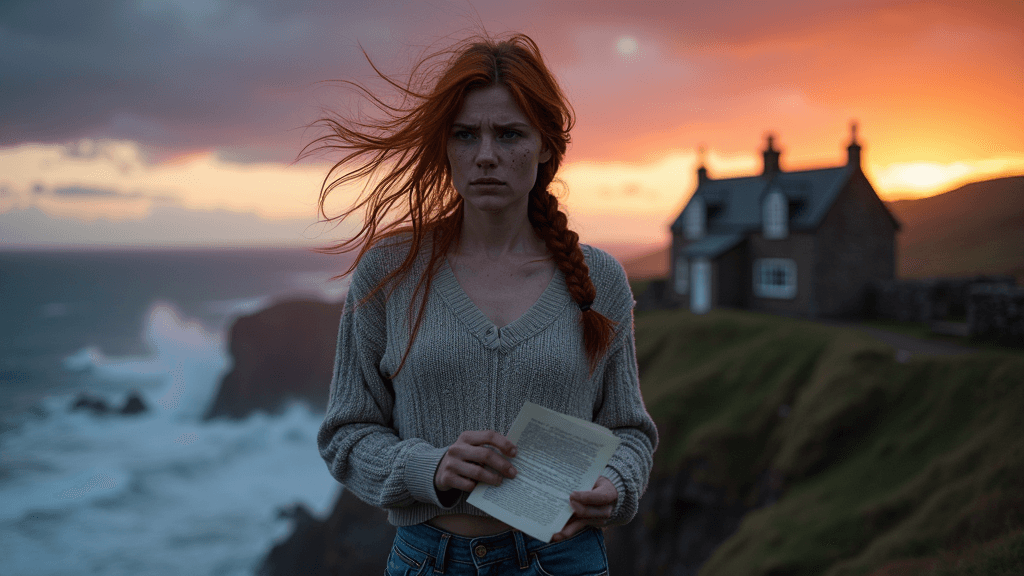
Le crépuscule la trouve seule sur le bord de la falaise au-dessus de son cottage, l'Atlantique s'écrasant en contrebas. Les documents de Philippe sont serrés dans ses mains engourdies par le vent. La caméra se rapproche de son visage alors qu'elle traite le choix impossible : refuser et préserver sa vie exactement telle qu'elle est, honorant l'héritage de son père et les attentes de la communauté—ou accepter et entrer dans un monde qui la terrifie.
Elle regarde en arrière vers son cottage—petit, familier, sûr. Puis vers le bas sur la photo de sa grand-mère—élégante, inconnue, une porte vers quelque chose qu'elle ne s'est jamais permis de vouloir.
Le vent arrache les papiers. Son expression passe par la peur, le désir, la détermination.
« Tha mi deònach, » murmure-t-elle au vent, à la lande, au fantôme de la femme qui lui a laissé ce cadeau impossible. « Je suis prête. »
Elle se retourne vers le cottage où Philippe attend sa réponse, chaque pas délibéré, chaque pas une traversée vers un monde qu'elle ne peut encore imaginer.
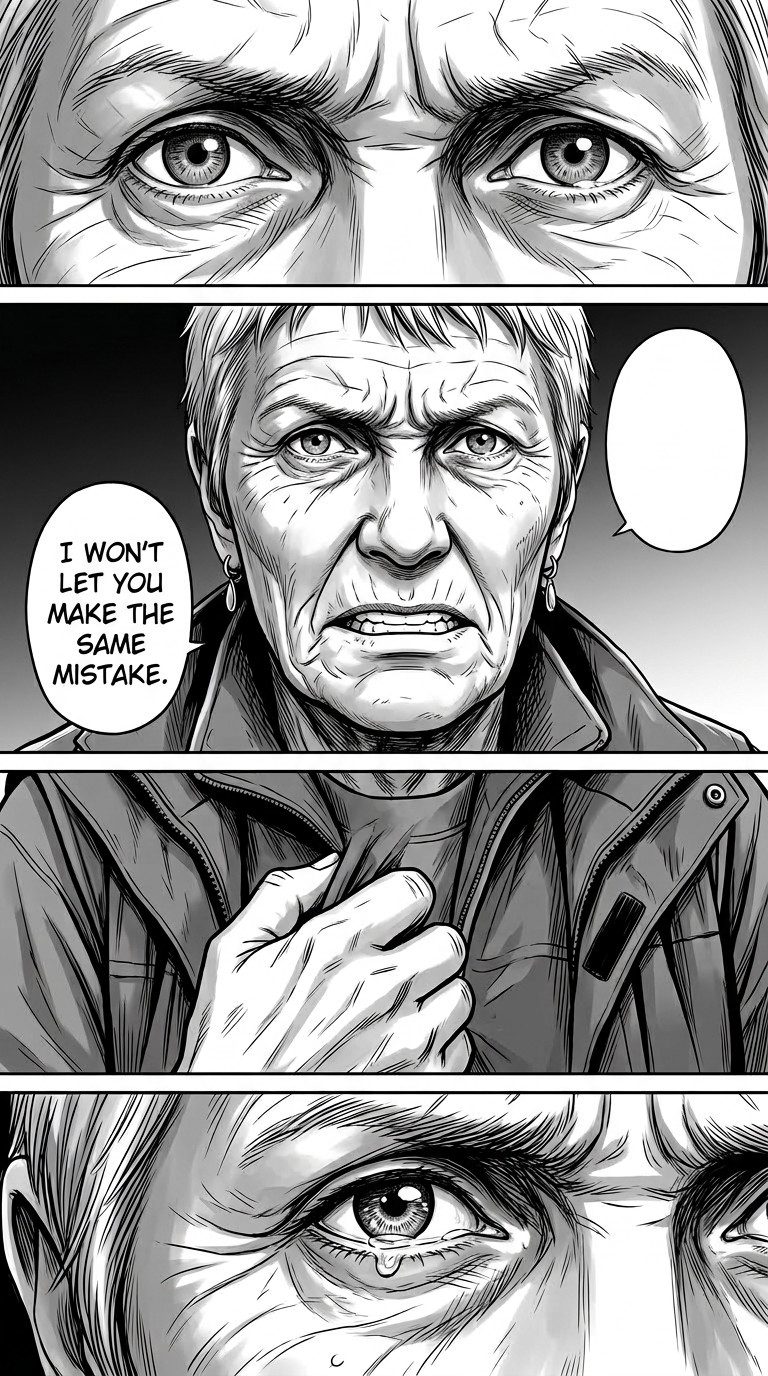
Aunt Catriona's severe face fills the frame. Her steel-grey hair and deep-set blue eyes are set in grim determination. Her weathered face shows fear beneath the harshness. Her mouth is tight. She stands in Màiri's kitchen with squared shoulders ready for confrontation.
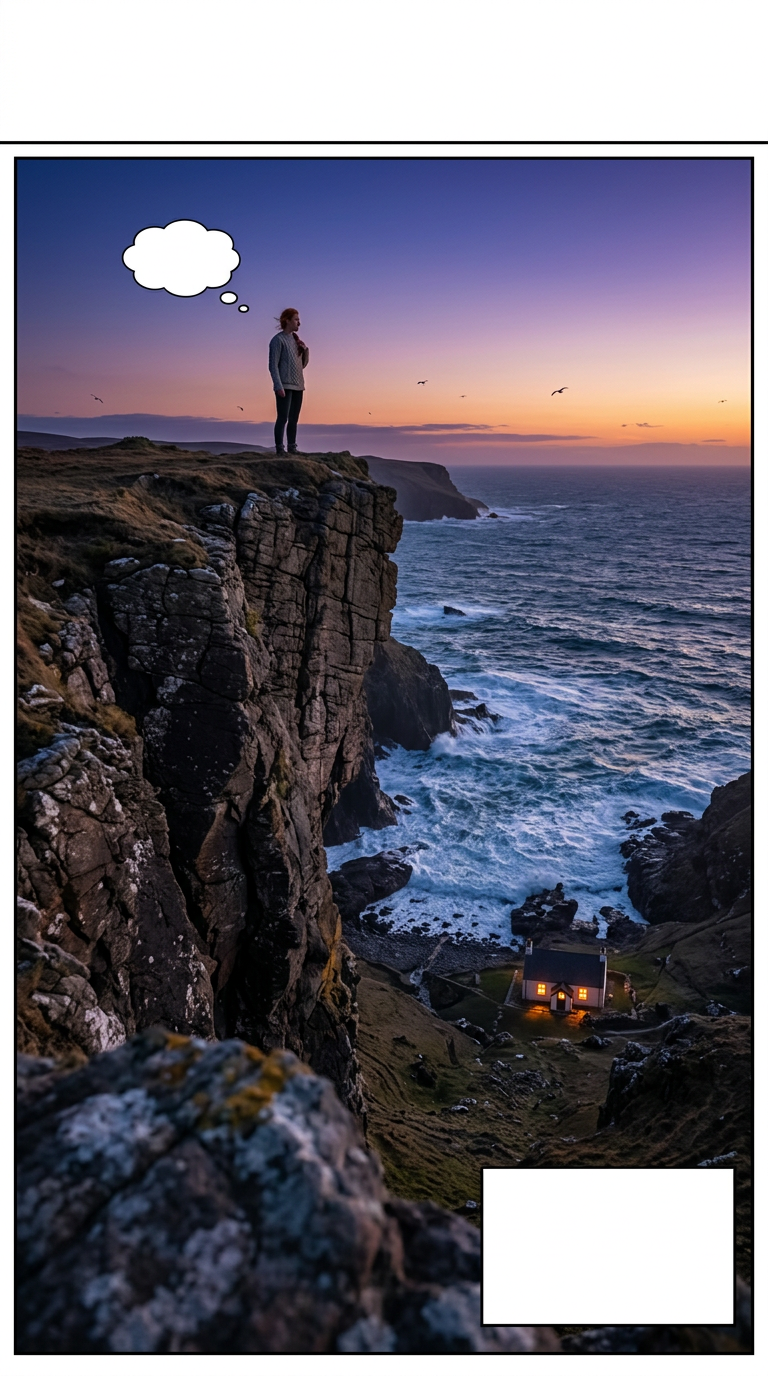
Twilight. Màiri stands alone on cliff edge above her cottage. The Atlantic Ocean crashes below in dramatic waves. Her small cottage is visible far below, lights beginning to glow. The sky transitions from blue to purple to orange. She is silhouetted against the vast seascape.