

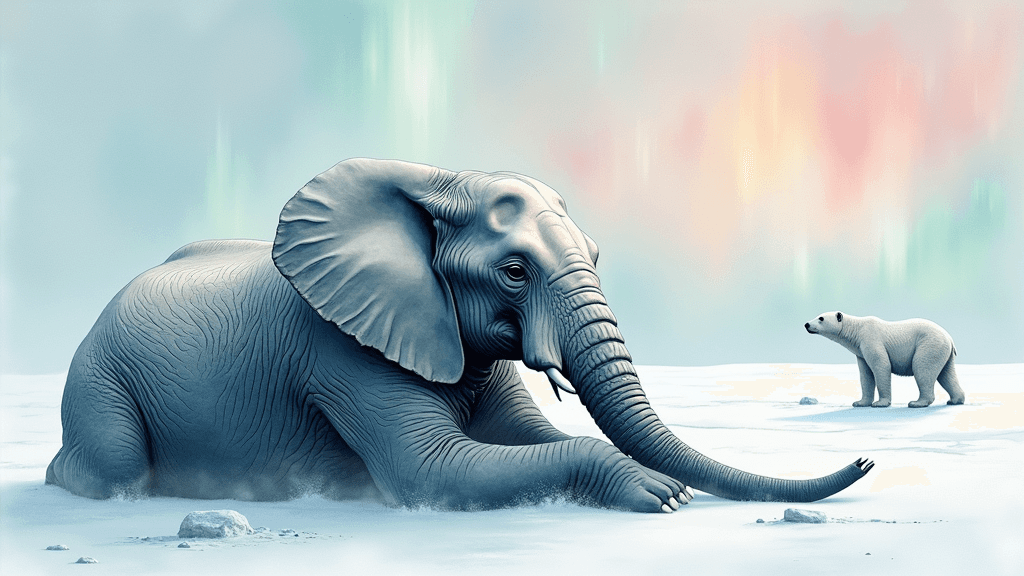
Consciousness returns like a distant wave rising from the depths. At first, there is only the cold—a cold so intense, so total, that it becomes almost a living entity devouring every particle of warmth. Maharaj opens his eyes.
White.
Everywhere. Absolutely everywhere. No horizon, no boundary between sky and earth. Just the blinding white immensity that burns his retinas even through half-closed eyelids. His massive body lies on a hard, slippery surface—ice. Smooth. Merciless. No trace of the red, warm earth he has known all his life.
His muscles protest violently when he tries to stand. His legs slip on the frozen surface, searching for purchase that doesn't exist. Once, twice, three times—he slides, his enormous weight working against him. Finally, leaning on his trunk like a cane, he manages to partially right himself, his legs spread wide to find balance on this hostile terrain.
Where... where are the acacias? The question echoes in his fragmented mind. Where is the red earth that has carried my steps for so many seasons?
The silence is deafening. No bird calls. No distant roars. Not even the buzzing of insects. Nothing but the occasional crack of ice beneath his feet, as if the world itself were slowly breaking apart. And the wind—oh, that wind that cuts through his thick hide as if it were transparent, finding every crevice, every weak point in his body.
Maharaj turns slowly, hoping to recognize something—anything. The acacias of the African savannas. The ochre rocks of ancestral lands. But there is only ice, only white, only this crushing silence.
His memory is fragmented, scattered. A storm. Black water rising, rising, rising. His mother's trumpet, distant, desperate. The herd scattering in confusion. A sensation of falling. Suffocation. Then nothingness. But how did he get here? How did he survive that water that tore him from everything he loved?
In the distance, the sky begins to change. The last vestiges of day disappear, and something strange takes their place. Lights. Waves of green and purple light dancing in the twilight sky, undulating like living creatures. Maharaj watches them, fascinated and terrified at once.
He trumpets—weak, trembling, almost a question rather than a statement. The sound is smothered in the immensity, swallowed by this white void that seems never to end.
Fifty meters away, on an elevated ice promontory, two pairs of eyes observe the arrival of this impossible intruder.
Nanuraq, master of this territory for fifteen winters, senses something changing in the air. Not a familiar scent. Not the musk of seal, not the marine smell of fish. Something else. Something gray. And massive. So massive that even from afar, the polar bear understands that this creature doesn't belong here.
Beside him, Kaluk—his young son, barely more than a cub—trembles with excitement rather than fear. His black eyes shine with a curiosity that Nanuraq recognizes, a curiosity that must be broken quickly if the youngster wants to survive.
Nanuraq growls, a deep sound emanating from the depths of his chest. The order is clear: obedience. Kaluk obeys reluctantly, his small paws carrying him back toward the entrance of their den dug deep into a mound of ice. But he continues to glance backward, unable to tear his eyes from this impossible creature.
Alone now, Nanuraq begins his approach. He moves with surprising grace for a creature of his weight. Each step is calculated, silent. His white fur blends him almost perfectly into the icy landscape—an advantage only an Arctic predator possesses.
Maharaj, busy exploring the frozen surface, discovers a rocky outcrop emerging from a snowdrift near a beached iceberg. With his trunk, he gently probes the snow and finds what he's looking for: gray, desiccated lichens, algae dried by the wind, a few frozen roots. The taste is bitter and repugnant, but he consumes them gratefully. His stomach protests. It's not enough, but it's better than nothing.
That's when he feels it. That presence. That attention. Maharaj straightens slowly, his eyes searching for the source of this primal sensation: something is watching him. Something hungry.
Fifty meters away, Nanuraq waits. Motionless. Patient. His amber eyes fix on the elephant with calculated intensity. The two creatures size each other up across the distance.
Nanuraq charges.
It's sudden, violent, unexpected. His powerful paws hammer the ice, propelling his two tons toward the intruder. A charging polar bear is a force of nature—a creature of muscle and primal fury. Maharaj, despite his exhaustion, reacts by instinct.
He rears up on his hind legs.
The impact is brutal. Maharaj's tusks meet Nanuraq's forepaws in an explosion of force. The polar bear feels the elephant's mass, feels the power in this body trembling with cold. Sharp pain shoots through Nanuraq's shoulder—a minor wound but enough to make him retreat, quickly reassessing his strategy.
This intruder is not easy prey. Not alone, at least. Not today.
Nanuraq repositions himself, growling deeply. Warm blood flows from his wound, contrasting with the white ice. Maharaj breathes heavily, his tusks pointed toward the polar bear, but he sees the hesitation in his adversary. Two creatures size each other up again, about thirty meters apart, each respecting the other's brute force.
That's when Kaluk, disobeying, approaches slightly, his eyes shining with forbidden curiosity. Nanuraq growls a fierce warning, but the young cub advances another step.
It's a voice that changes everything.
A melody. A song carried by the glacial wind, an Inuit melody that seems to dance between the ice crystals. Maharaj turns his head toward this human voice, the first familiar sound since his awakening in this white nightmare.
Taqiq emerges from behind an iceberg, but not by chance. She has been patrolling since morning, having observed strange signs: massive tracks on the ice, debris from an unusual storm, agitated animals. She heard Maharaj's trumpet from her observation position, and she approached cautiously, her hands raised in a sign of peace. She has seen the impossible: an elephant on the ice sheet. Her heart races. The ancient legends spoke of a majestic creature coming to herald a change.
She continues to sing softly, a soothing melody, but she also uses the ritual gestures of her people—slow, circular movements, palms open. She removes her gloves to show her bare hands, a universal gesture of non-threat.
Nanuraq growls a warning but doesn't charge. There is something about this woman, something that commands respect even from an Arctic predator. He knows her. She has lived on these lands for years, and she has never been a threat to his territory.
Taqiq approaches the two creatures slowly, her gestures measured and calm. She places on the ice pieces of dried lichen, preserved sea algae, and a few willow roots she brought, knowing that any starving animal must eat. Maharaj, wary but desperate, approaches slowly, drawn by the plant food his body remembers.
Their gazes meet.
"You're not from here, creature of the south," Taqiq murmurs, her eyes filled with compassion and questions. "But perhaps the spirits sent you for a reason."
Maharaj doesn't understand the words, but he senses the benevolent intention in every gesture. He hesitates, then begins to eat the offered food awkwardly, his body trembling with relief. His instinct tells him this woman means him no harm.
Kaluk watches the scene, fascinated by this impossible interaction. Nanuraq remains vigilant, but he doesn't charge. There is something in this moment that transcends simple predator instincts.
Hours pass. Taqiq guides Maharaj toward a protected area between two massive icebergs, a place where the wind is less violent. She shows him how to use his trunk to probe the snow, where to find the lichens and dried algae that survive in this hostile environment. Maharaj learns slowly, his movements clumsy at first, then gradually more assured.
Nanuraq watches from afar, his shoulder wound reminding him to be cautious. This is not a creature he can eliminate easily. There is a calculation to be made, a strategy to develop. For now, he accepts the presence of this intruder, but he remains vigilant.
Taqiq observes this impossible elephant, her eyes filled with questions and compassion. She sees the suffering in his movements, the loss in his gaze. She recognizes in him something she knows well: the loneliness of being far from one's people.
Maharaj, sitting on the ice, suddenly remembers. The herd. His mother, with her great ears that spread like sails. His young brother, who followed him everywhere with admiration. The other females, protective and strong. Old Kavi, the patriarch who guided the group through the savannas. All gone. All swallowed by that storm that separated him from them.
He looks at Kaluk, who approaches cautiously despite his father's warning growls. The young cub has the same curious eyes as his young brother. Maharaj feels something break and rebuild within him. You remind me of those I left behind, he thinks, watching the young bear. Your curiosity is stronger than fear. It's a strength you must cultivate, not destroy.
Kaluk sits at a respectful distance, watching the elephant with silent admiration.
The wind begins to rise. The northern lights intensify, creating ghostly lights that dance violently in the sky. Clouds gather on the horizon. Taqiq looks up at the sky and frowns. She recognizes the signs. A major Arctic storm is approaching.
"We need to find shelter," she says, knowing that Maharaj doesn't understand her words but will understand her gestures. She points toward a nearby protected rock formation, a natural cave that the Inuit have used for generations.
Maharaj rises awkwardly, following Taqiq. Nanuraq growls, but he doesn't block the path. Kaluk wants to follow, but his father holds him back firmly, bringing him back toward their den.
That's when the sky explodes.
The storm arrives with sudden, terrifying violence. The wind howls, lifting the snow in white waves that completely erase visibility. Maharaj and Taqiq run—or rather, advance as best they can—toward the rocky shelter. But in the white chaos, Maharaj feels something sinister beneath his feet.
A crack.
The ice begins to give way. He is too heavy for this section weakened by ocean currents. Fissures spread rapidly around him, widening like hungry mouths.
"No... not like this," Maharaj cries, panic invading his voice. "Not in that black water that already took everything I loved!"
Taqiq tries to grab him, to guide him toward thicker ice, but the wind is too strong, the storm too violent. An entire section of ice breaks away with a thunderous sound. Maharaj slides toward the black, icy water, his trunk reaching desperately toward Taqiq as the storm howls around him.
From afar, Kaluk cries out, struggling against his father's protective grip. "We can't let him die!" the young cub screams. "We can't!"
Nanuraq holds firm, his eyes fixed on the scene with an indecipherable expression.
Maharaj disappears beneath the surface, engulfed by the Arctic ocean. But unlike the first time, this time he doesn't panic completely. His survival instinct takes control. He feels his feet touch something solid beneath him—not the bottom, but a structure. A wreck. A sunken ship, perhaps, or a submerged rock formation.
His lungs burn. The icy water pierces every fiber of his body. But there is a glow—a green glow emanating from the structure beneath him. And a passage. A passage that seems to lead upward, toward the light, toward life.
Maharaj pushes with his legs, using all his remaining strength. He must surface. He must survive. He must understand why the spirits brought him to this white, frozen world.