

The Impossible Note
The siren tore through the night before Maya understood what she had done.
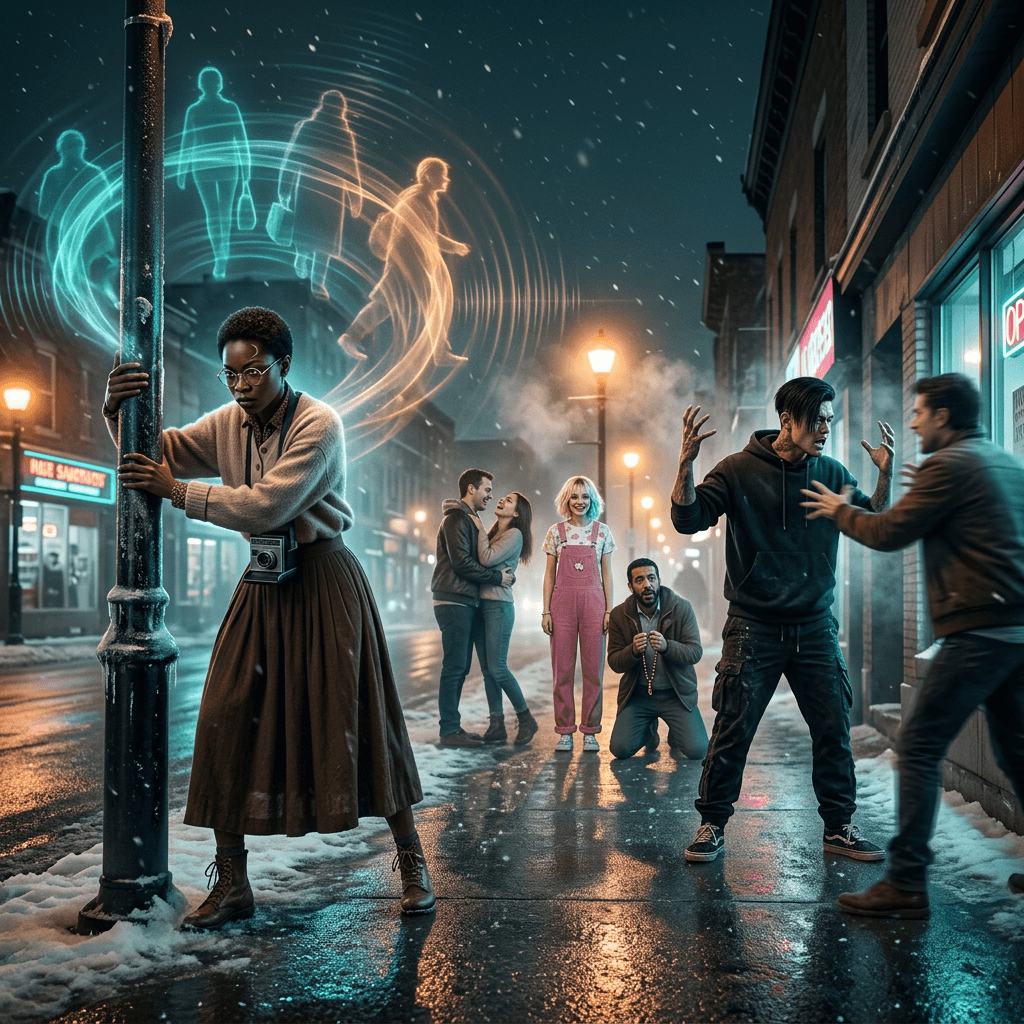
Saint-Viateur Street, hands trembling, she stared at the collapsed man. Around her, four frozen silhouettes. Behind them, the warehouse still belched bass.
Seventy-seven seconds earlier, they were just five friends who came to listen to music.
Now, the stranger's memories were seeping into her mind—his daughter dead in 2003, the whisky, the Jacques-Cartier Bridge where he'd almost jumped.
She pulled her hand from the lamppost. Too late.
"What just happened?" Thomas was shaking. "Fuck, what just happened?"
Maya knew none of them had an answer.
Eight hours earlier.
Café Resonance. Gray November light. Maya framed the group in her Polaroid. Flash.
"Again?" Thomas shifted. "You've taken like fifteen photos today."
"One hundred fifty-six consecutive Thursdays. I like having archives."
Léa hummed, pink hair catching the light. Karim watched the street. Inès sipped her espresso, studying each of them.
"My dad wants me to 'finally grow up,'" Thomas said. "Meanwhile, they just raised my grandmother's rent by forty percent."
Léa placed her hand on his arm. "This concert tonight is going to be exactly what we need!"
Maya lowered her camera. A figure stood across the street, hood pulled up. Their eyes met. The man walked away.
"Did you guys see that guy?"
Only Karim looked up, too late. "What?"
"Nothing. Just a feeling."
But Karim was watching her with intensity, as if reading something she hadn't said.
Inès tapped her phone. "The address just dropped. Abandoned warehouse, Saint-Viateur Street. Eleven p.m." A minimalist poster: SONIC SPECTER. The logo was a spiral that seemed to rotate.
"These underground concerts always attract the same types," Inès said. "People looking for something they can't find."
"Like us?" Léa laughed too loud.
"Exactly like us."
Maya photographed the group one last time. On the opposite wall, someone had painted a spiral identical to the poster's. The paint was still wet.
Orange Line toward Rosemont. Ten-fifteen p.m. Thomas was telling how a cop had searched him last week "because I looked suspicious." Léa hummed, eyes closed. Karim watched the passengers. Inès read without turning pages.
Maya noticed the figure two cars back. Same hood.
She leaned toward Karim. "You see him?"
Karim nodded. "Since the café."
"Why didn't you say anything?"
"I felt like we shouldn't go. Like pressure here." He placed his hand on his chest. "But I didn't understand why."
The metro stopped. Rosemont. They got off. The figure did too.
The warehouse loomed like a carcass of metal and red brick. A line of fifty people snaked toward the entrance.
Maya photographed the façade. Ten twenty-three p.m.
Inside, neon flickered—electric blue, blood red, sickly white. Smell of cold metal, electricity, ozone.
Maya raised her Polaroid. Flash. In the shot, symbols carved into the walls—interconnected spirals. The patina suggested decades.
"These marks aren't from yesterday."
Karim placed his hand on the metal, pulled it back as if burned. "There's a lot of emotion here. Old."
The crowd thickened. Three hundred people waiting for something they couldn't name. On every Polaroid that developed, behind the group, the same blurred shape. The hooded figure.
"You see her?" Maya whispered to Inès.
"Yes. He's been watching us since we arrived."
"Why didn't you say anything?"
"Because I want to see what he wants." Inès turned to Karim. "You knew we were being followed too. Why didn't you say anything?"
"I didn't understand what I was feeling."
"Or you knew exactly what was going to happen."
"Stop." Maya stepped between them. "We're all stressed—"
The music began.
Imperceptible vibration. Slow crescendo. Unknown instruments—metal pipes, glass plates, machines producing frequencies that resonated in the bones.
The crowd danced. Not naturally. Like puppets.
Maya felt something shift. An internal vibration. Thomas breathed with difficulty. Léa wept while dancing. Karim collapsed against a wall. Inès remained still, fists clenched.
The music rose.
Then, at eleven seventeen p.m., an impossible note sounded.
Time fractured.
But only for the five of them.
Maya saw the scene freeze—dancers suspended, mouths open. Then she fell through layers of reality. Hands touching this metal in 1952. Voices carving these symbols in 1981. Hundreds of faces screaming, crying.
Around her, her friends lived their own nightmares. Thomas screamed against a father who rejected him. Léa reached toward a dying mother. Karim collapsed under an ocean of emotions. Inès struggled against regrets.
Then it stopped.
They regained consciousness on the floor, trembling. The concert continued. Dancers moved as if nothing had happened.
But around the five friends, the air shimmered.
Maya checked her watch. Eleven seventeen p.m. Stopped.
Her phone: black screen.
"We're leaving," Karim whispered. "Now."
Outside, Thomas vomited against a wall. Léa collapsed on a bench. Maya tried to control her breathing.
"It was a drug," Thomas said without conviction.
"The others weren't reacting," Léa replied.
Maya touched a lamppost to steady herself.
Mistake.
Deluge. Decades of memories—everyone who'd touched this metal. A woman in 1987. A man in 2012. A teenager in 2019. And this man who'd just passed, thinking about the Jacques-Cartier Bridge, the whisky, his daughter dead—
"No no no..." Maya pulled her hand away. The man collapsed three meters away, eyes rolled back.
Thomas rushed over. "Sir? SIR?"
Passersby stopped. Someone shouted to call an ambulance.
"What do we do?"
"We leave," Inès said. "Now."
"We can't just leave him—"
"We LEAVE."
Two passersby approached. "Were you with him?"
Thomas raised his hands, frustrated. "I don't know, okay?"
The rage exploded.
Literally.
The two passersby froze, then threw themselves at each other with animal violence. A woman slapped her companion. A teenager shoved a man who crashed through a window.
Five people infected by Thomas's anger fighting in the street.
"That's not me doing that!" Thomas backed away, horrified.
But he knew it was.
Léa raised her hands. "Please, stop!"
They froze. Paralyzed in empty laughter, dead eyes, mechanical smiles.
"What did I do?" Léa stepped back. "WHAT DID I DO?"
Sirens. Distant, approaching.
Karim collapsed. "I feel everything you're feeling. And them too. It's too much, it's TOO MUCH—"
Inès closed her eyes and suddenly she knew. The woman's regrets—she'd slapped her son this morning. The teenager's regrets—he'd stolen his mother's wallet. The man's regrets—his daughter dead, he should have been there—
"Make it stop."
But nothing stopped.
Two ambulances arrived. Then a police car.
"We have to leave," Maya said. "Before we hurt anyone else."
They fled through the Mile-End alleys, powers manifesting chaotically. Each contact released a wave of emotion. Léa kept her hands in her pockets, crying. Thomas walked in silence, terrified. Karim guided the group, avoiding crowded areas.
Inès stayed behind, watching. Calculating.
Maya's apartment, one forty-five a.m. Four and a half on the Plateau, third floor. They barricaded themselves, drew the curtains.
Outside, sirens. Close.
Thomas positioned himself near the window. "They'll find us. We hurt people. There are witnesses. Cameras."
Maya developed the Polaroids, arranged them on the table. In every photo, the hooded figure. Clearer. Almost recognizable.
"Look. This person I didn't see when I took the photo."
Karim examined the photos. "I know this silhouette. I don't know how, but I do."
"How can you know someone when you can't even see their face?" Thomas got angry. "Unless you know exactly who it is. Unless you've known from the start."
"I swear I didn't—"
"Then why didn't you tell us we were being followed?"
"Because I didn't understand! I felt something was off, but I didn't know what."
"Or you knew exactly," Inès said calmly, "and you wanted to see what would happen."
Silence.
"Why would I do that?"
Inès looked at him. "Because you absorb other people's emotions. Because you spend your life carrying everyone's pain. And maybe you wanted to finally understand why."
Karim opened his mouth, closed it. His eyes glistened.
"Stop." Maya raised her hand. "Tearing each other apart won't solve anything."
A knock at the door.
Everyone froze.
Silence.
An envelope slid under the door.
Maya picked it up. Thick vellum paper. Blue ink. Inside: a card with the spiral symbol and a handwritten address: Tunnel beneath Place d'Armes, entrance through Fortifications Alley.
And a sentence: You're not the first. We need to talk before they find you. — E.B.
Inès opened the door. The alley was empty. But on the opposite wall, the spiral symbol. The paint still dripped.
"Someone followed us here," she said. "And someone else is sending us messages."
She turned to Karim. "You know these initials?"
"No."
"You're sure?"
"I swear I don't."
But Inès didn't believe him.
Maya examined the envelope. The handwriting trembled—someone emotionally unstable. The initials E.B. resonated, familiar but elusive.
"This person knows who we are. She knows what happened to us."
"It's clearly a trap," Thomas said.
"We're already in a trap," Maya answered. "Ever since we walked through that warehouse door. The only question is: do we want to understand why?"
Léa stood up, hands trembling. "What if it's someone who turned us into monsters?"
Karim closed his eyes. "I feel fear. A lot of fear. But also guilt. And determination. Whoever wrote this is afraid of us, but also for us."
"Or you're manipulating us," Inès said.
Karim looked at her, anger in his eyes for the first time. "If I wanted to manipulate you, Inès, I could absorb all your guilt right now. All that pain you've been hiding for years. I could take it and leave you empty. But I don't. Because unlike you, I don't turn people into weapons."
Inès went pale.
Maya looked out the window. The sirens had stopped. But she knew it was temporary. Somewhere, people were waking up in hospitals. Videos were already circulating.
They maybe had an hour.
"We're going," she said. "Together. We find this person, we get answers, and we decide after."
"What if it's a trap?" Thomas asked.
"Then we face it together. Because we just discovered we can hurt people without meaning to. And if we don't understand what's happening to us, how long before we kill someone?"
No one answered.
Because they all knew the answer.
Outside, the hooded figure watched the apartment from an adjacent roof. Waited. Knew.
In a pocket, a second envelope. Addressed to someone else.
And in the city's underground, in tunnels that maps don't show, a woman waited. A woman who'd heard the same impossible note forty-three years earlier.
A woman who had survived.
But every memory she'd lost was carved into the wrinkles of her face, into the tremor of her hands, into the emptiness in her eyes when she tried to remember her own daughter's name.
She placed her hand on the spiral symbol carved into the stone wall.
"They're coming," she whispered. "Finally."
And in the tunnel's darkness, something answered.
Not with words.
With a vibration. A frequency. A note that should never have existed.
The same note that started it all.
The same note that would destroy everything.